The World of Calipedes...
How did Calipedes come to be?
The story of the Calipedes begins on the International Space Station with a cluster of tardigrades. There the creatures rest, deep in cryptobiosis, oblivious to all around them. Down, miles and miles below them, tensions rose. A selfish and fearful species, the ones who called themselves human, began to fight. They started by shouting, mere disagreements popping up between leaders across the earth. Then, as though they'd all been holding their breath, waiting for a reason to attack, a war broke loose. Ugly, angry, and needlessly violent, the species that spent so long studying the tardigrades, praying they could learn to do what they did best and survive, began to crumble. Soon it was not just words but guns, then there were bombs, after that the nukes came. Up in the stars, the astronauts wept, watched as their homes began to fog and splinter, watched as cities leveled and societies collapsed in utter helplessness. Some called themselves blessed, chosen, others thought it was a curse to watch their families fall with the world.As the last bomb dropped and the atmosphere began to cloud, the last of humanity stood together. They spent the rest of their lives trying to bridge language gaps, to pile all of the research they'd done together, prayed to their gods and held each other as they cried. They poured themselves into their research obsessively--if they could just figure out how to replicate this state of resilience, if they could somehow achieve human cryptobiosis, there could be a world where they'd each had a chance to honor their families, to stand on their planet and breathe in real air, touch real grass, feel a breeze as it tickled their skin.But time is especially cruel.As the last humans began to grow old, their bodies in turn weakened. Maintenance was hard, nearly impossible. Research was hard too, brains beginning to fog and eyes going blurry, creaky joints and gray thinning hair, the humans were going extinct. So, one by one they fell until none remained. Slowly, the power to the ISS faltered, and then the air flow, the simulated gravity, over one hundred years parts became loose and severed, until the ISS came crashing down to earth. Deep in a now unknown continent, a chunk of metal that happened to house the colony of tardigrades landed in a river. Next to that river, a jagged chasm sliced further into the earth than any eye could possibly see. Later they would call it The Rift, but right now it provided life, a metamorphosis. Quickly the tardigrades changed: they grew and warped and evolved faster than the earth could spin. arcane energy twisted and merged with once solid DNA like a beautiful dance, shaping and molding the new creatures to it's will.The beings that emerged from the river were no longer microscopic, but instead furred, animalistic, conscious things with teeth, eyes, paws, ears, and tails. They were doglike but not quite, too many limbs and conduits made of raw arcana, too many off balances and inconsistencies that made it hard to put them under any human term or box. No matter what, one thing was for sure. They thought, felt, spoke, acted. They knew they existed in a way only humans ever had.And so, like the humans that destroyed the ground beneath them so long ago, they named themselves. And they were called Calipedes.
Where are they now?
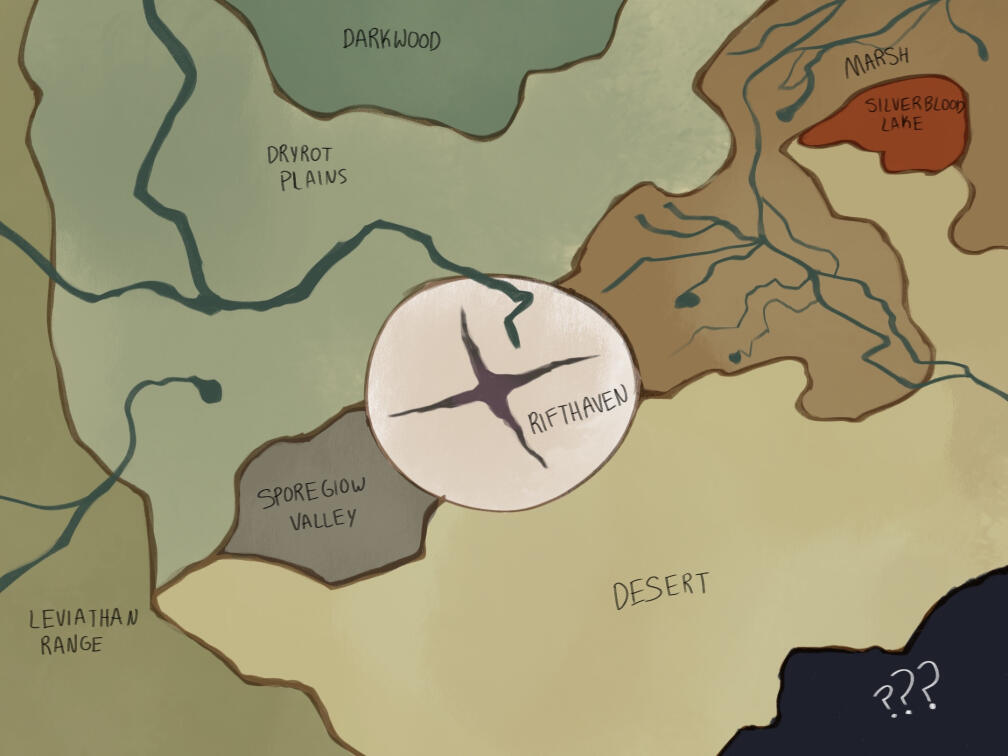
Calipedes are social creatures that have by and large settled in Rifthaven, a city centered around the Rift.By the time the Calipedes crashed, the dust had settled and the planet had changed. With it, The Rift opened, bringing the arcane into the world. The tangles of magic and remnants of the weapons used to destroy the world transformed the things on its surface, making it completely unrecognizable. While some things were restored to new life, the radiation was also held dormant by the magic in the air. About 100 years ago, a space station that had been slowly degrading finally crashed into the Earth, pulled by its gravity.The Calipedes, also known as critters, settled in a city around The Rift. The Rift stretches widely in each cardinal direction, a deep and nondescript gouge in the earth. Nothing thrown down it returns or makes a sound. Light shone into it does not reflect any sort of cavern walls, instead dying as if at the surface of a black hole. The Rift gives off a purple glow, despite its ability to eat light around it. It is the source of all magic, however, so they've made their home around the thing. Bridges stretch across the chasm, connecting the land that's quartered. A densely-packed city sits close to the center of the Rift, where most Calipedes live. Sparser suburbs and farmland spread out from the city, though. The bounds of Rifthaven are defined by a magically-enforced energy field that keeps most dangers outside.Rifthaven is led by the Riftkeeper, a yearly-elected figure. They have influence over everything happening in the city, from major changes to patrols outside the city limits. They unify the people and create or change rules with said people's best interests in mind.
What is Arcane magic?
The arcane exists as a form of magic. It came from The Rift, which serves as the epicenter of the arcane. Calipedes can willingly harness the arcane in spells, but they're also biologically predisposed to it; the 10 conduits on the body (6 on the flank, 2 on the head, 2 on the tail) hold the arcana a Calipede can use. These both harness and protect the Calipede; without these anchors, the magic would overwhelm their body and create instability, possibly damaging or even killing the Calipede.There are 4 base arcanic types that a Calipede can be born with:Core arcana focuses on the earth. Magic in this discipline is largely used defensively (harnessing the properties of stone and metal as armor) and for the fortification of structures. The most notable spells cast by Core magic users include finding precious minerals, producing large spikes of earth, and producing metal. Critters who work with the core arcana are seen as down-to-earth and rugged.Sea arcana focuses on water. The magic used here manipulates ice and liquid water and this discipline focuses largely on exploration skills- long journeys are aided by knowing there will always be a reliable source of water, after all! Critters with this focus also tend to explore underwater ruins, thrive in the swamps, and do well in jobs where water flow is important (infrastructure planning, farming, etc). Many of their most important spells include calling water from the earth or sky, turning water to ice in combat, and making themselves temporarily able to breathe underwater. These critters are stereotyped as being go-with-the-flow, adventurous, and creative.Sky arcana focuses on the manipulation of wind, weather, and air. Their most important spellwork tends to include creating storms during drought periods (with the help of Sea magi), the manipulation of lightning, and making themselves temporarily able to fly. Their magic is almost entirely offensive in battle. Sky magi are seen as fierce, easily-provoked, and powerful. They usually work in positions that see a lot of conflict, such as guarding or patrolling.Surface arcana involves the manipulation of plants and animals. These magi can foster the growth of plants, communicate long distances through root systems, and have intense empathy with animals. It's a useful trait to have in agriculture and exploration, where understanding the natural world around you can be life or death. Surface magi are seen as pushovers, calm, and empathetic.But there are more types of magic to be discovered...
The Beastiary of Calipedes
Domesticated Animals
Those kept for either agriculture or as pets.
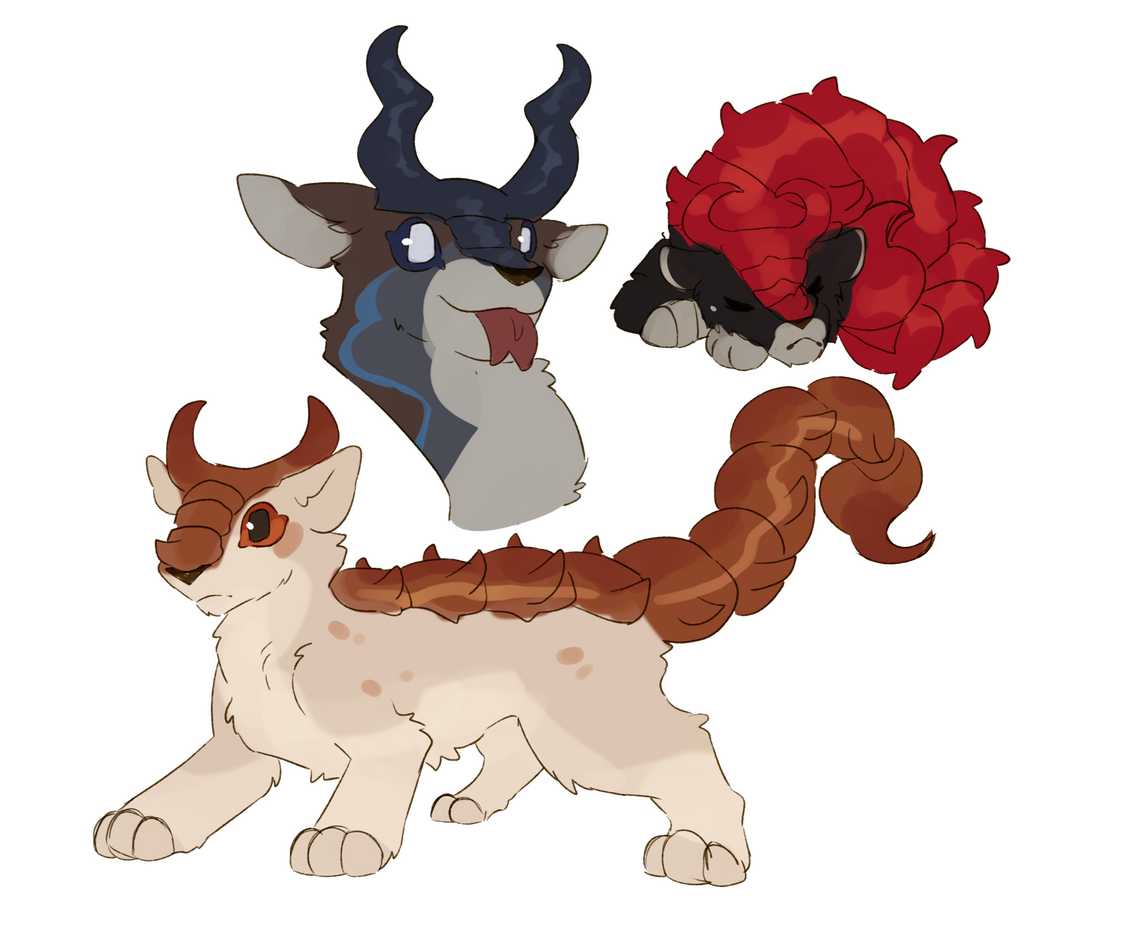
Scorptails
Large, houndlike mammals with thick chitin shells on their back. They can be almost any color or pattern, with two large horns on their head and stingers at the tips of their tails. They're incredibly intelligent and the default choice when looking for a companion in any field of work or as a service animal (though they're not the only choice.) They can range in size from 2-3 feet at the shoulder. They live about 20 years on average and are omnivorous, eating both plants and small animals.
Vented Drakes
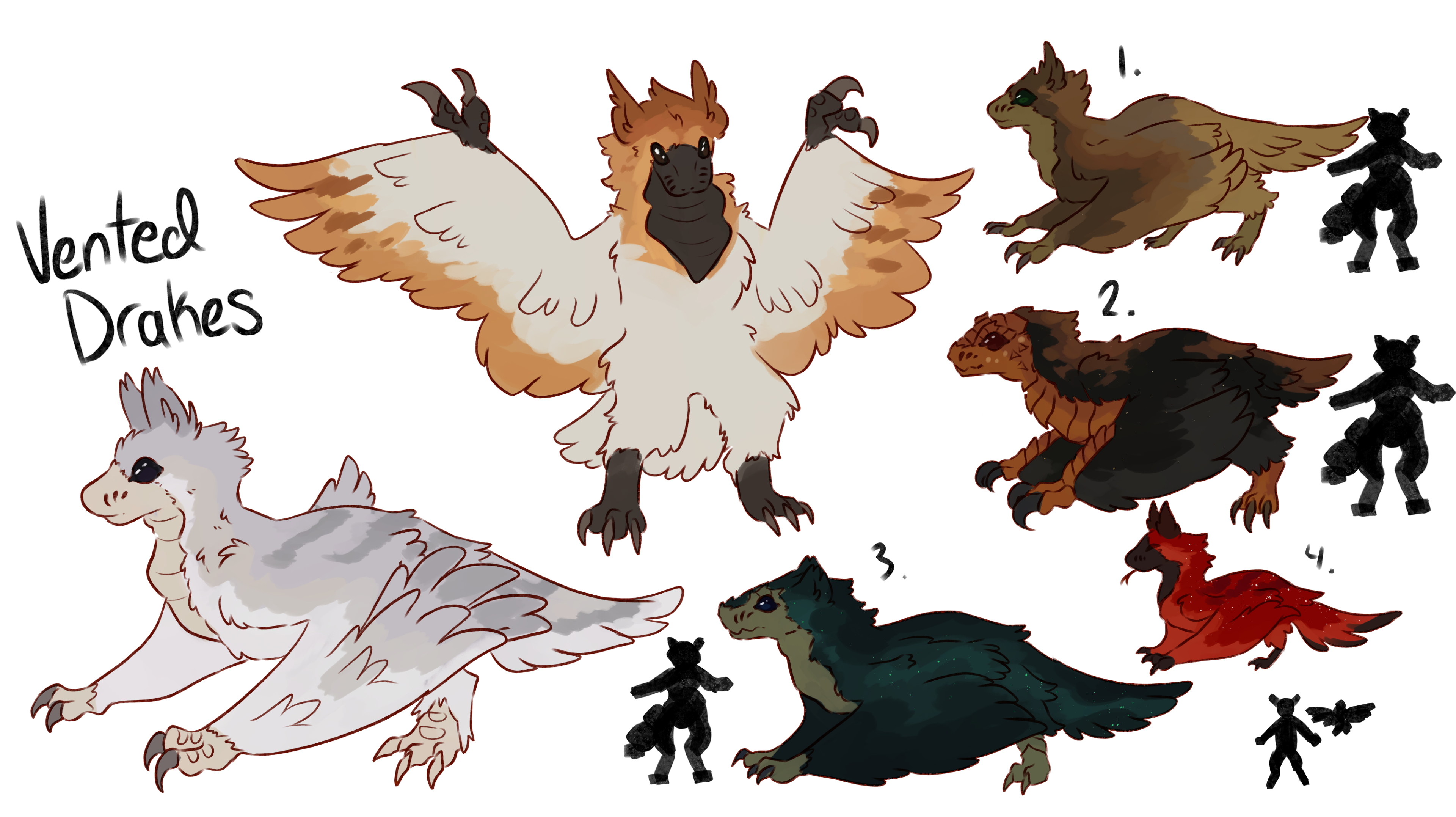
Vented Drakes, also known as Pitraptors, are large avian creatures that are highly intelligent. They serve many uses amongst critters, though their primary purpose is generally to be ridden. As obligate carnivores, vent drakes can be somewhat difficult to feed. Their size means their appetite is hard to sate and a failure to satisfy them may be detrimental to ranchers' livestock. The average vent drake has a scaled face and neck, birdlike talons on their wings and hind legs, and a thick feather cover over their body. These colors and scales can be any color, with prestige breeders searching for certain looks. These creatures come in 4 breeds:
1) Racers. Medium-sized and specializing in speed, this is the most common variant of Pitraptor. They have faux ears and long wings, generally built for tight turns and reliable travel, but only being able to carry one adult critter.
2) Armored. Relatively small, the armored vent drake is specialized in battle. It sports scaly protection all the way down its underbelly, a fully scaled face, and wicked claws. Slower and unwieldy, an armored vent drake can't fly with passenger for very long. They aren't very practical for exploration, as such, but are advantageous on patrols. Their smaller size also makes them good for journeys that involve mountains, as their compact nature and musculature is well suited for harsher terrain.
3) Passenger. The largest of the breeds, passenger vent drakes are suited for carrying multiple passengers and heavy cargo long distances. They're ill suited for fighting, however, and are a liability in battle if it comes to it. Passenger vent drakes also have short, stocky faux ears.
4) Miniature. The miniature vent drake is about the size of a cat and has a similar temperament. Used as messenger creatures, they're able to be trained for a variety of tasks and are generally seen as good companions.
Plainwalkers
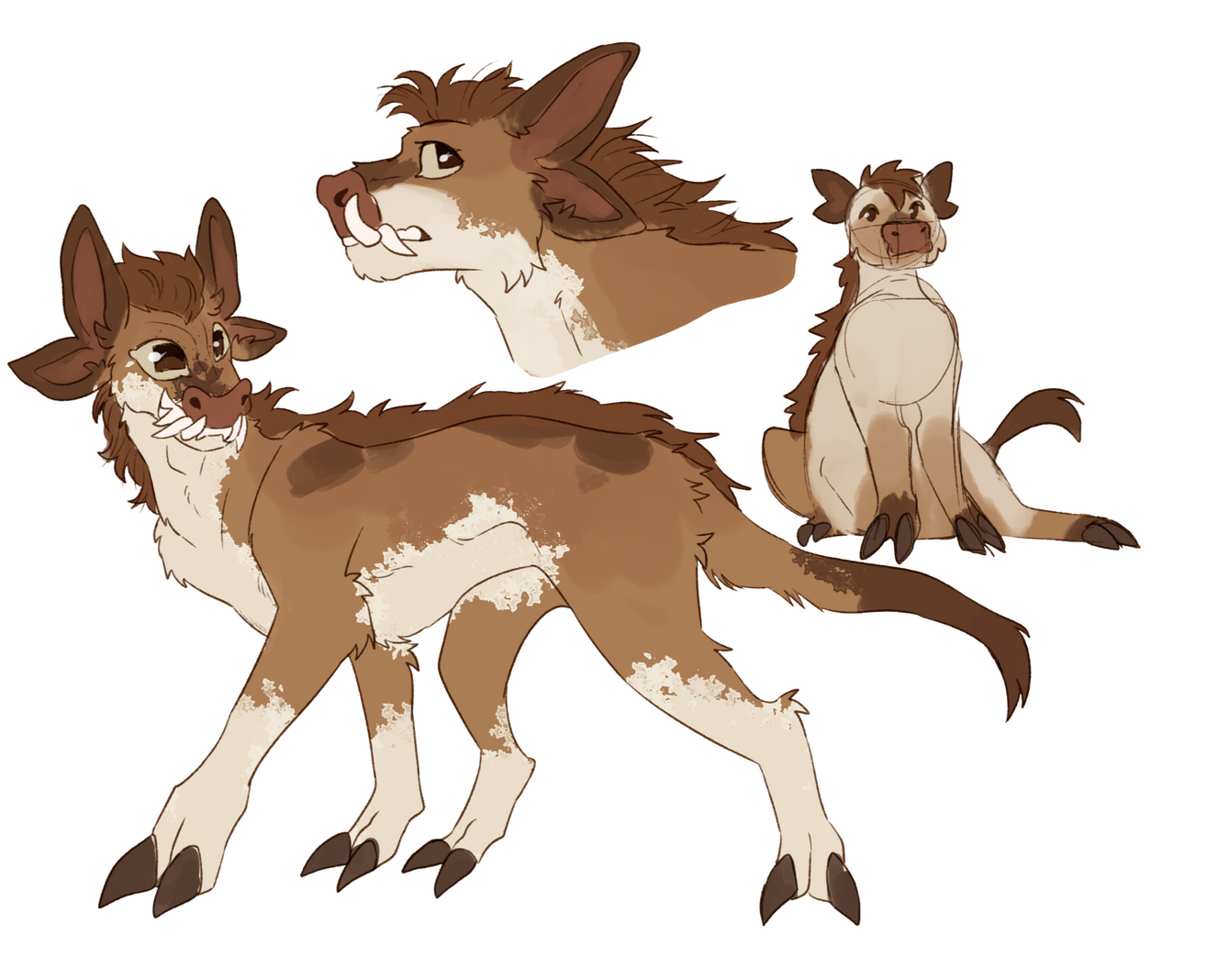
Plainwalkers have long, two-hooved legs and big ears. They're large, standing taller than a critter by a sizeable margin, but are generally of decent temperament. They are used for work on farms and for long-distance travel, being reliable mounts. They can be dangerous if provoked, however, on account of their size, strength, and sharp hooves and teeth. They are not afraid to fight back if they feel they are provoked. Though someone unsettling looking at times, Plainwalkers are very sweet and reliable animals used by many. They live for a long time and bond to their owner, recognizing faces.
Shmeep
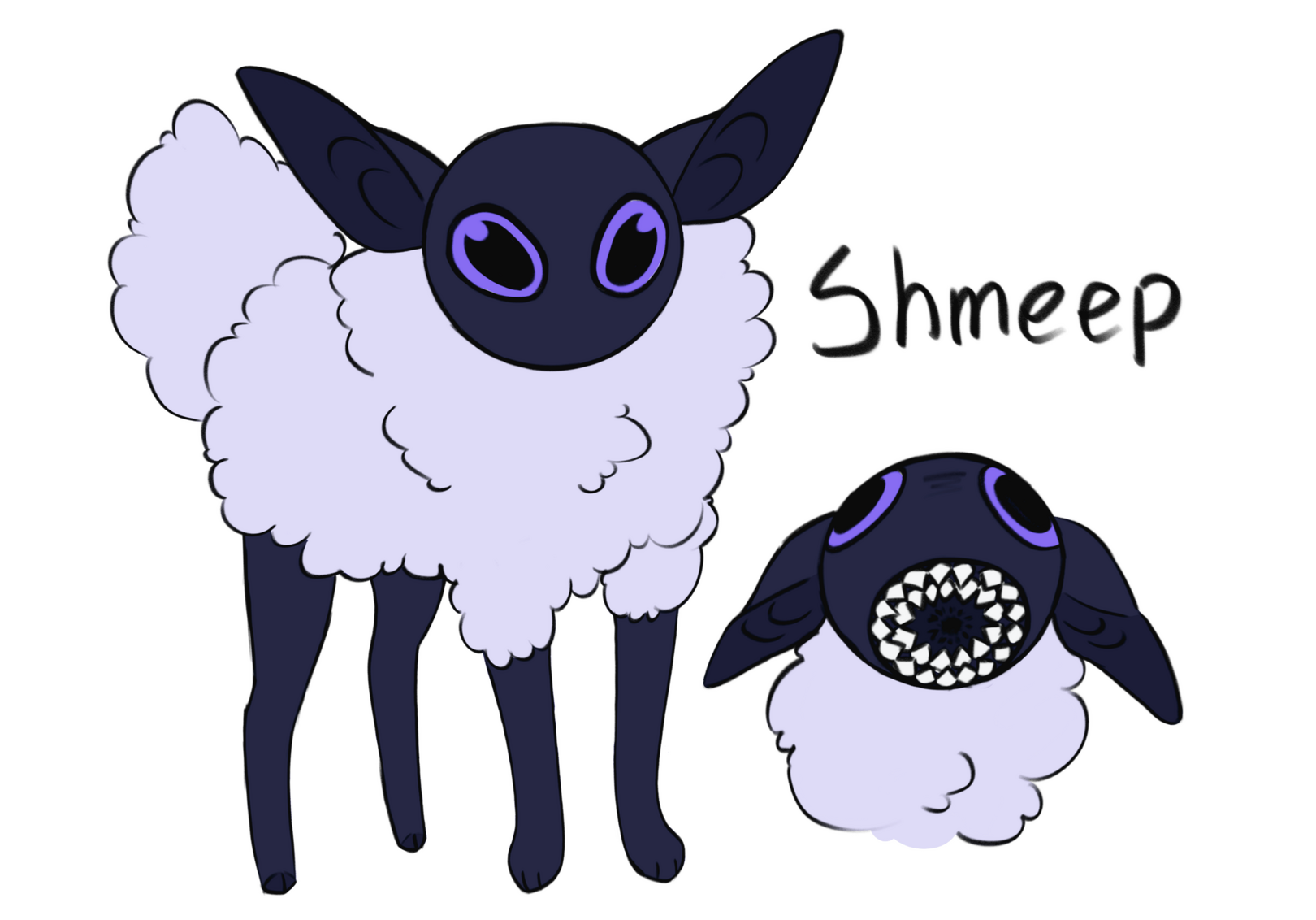
Shmeep are often used in agriculture, as their wool is very soft and good in textiles. They are also kept as house pets, as their neutral temperament and tendency to eat just about anything you put in their endless expanse of a maw makes them good for compost. They're well-liked and generally viewed fondly by most, even if their mouth can be off-putting. They are generally light-colored in their wooly areas, with dark, saturated colors on their limbs. Their eyes tend to be an uncanny bright color.
Wild Animals
Generally advised to stay away from, as many are dangerous. Found outside the borders of Rifthaven, for the most part.
Samara Gliders
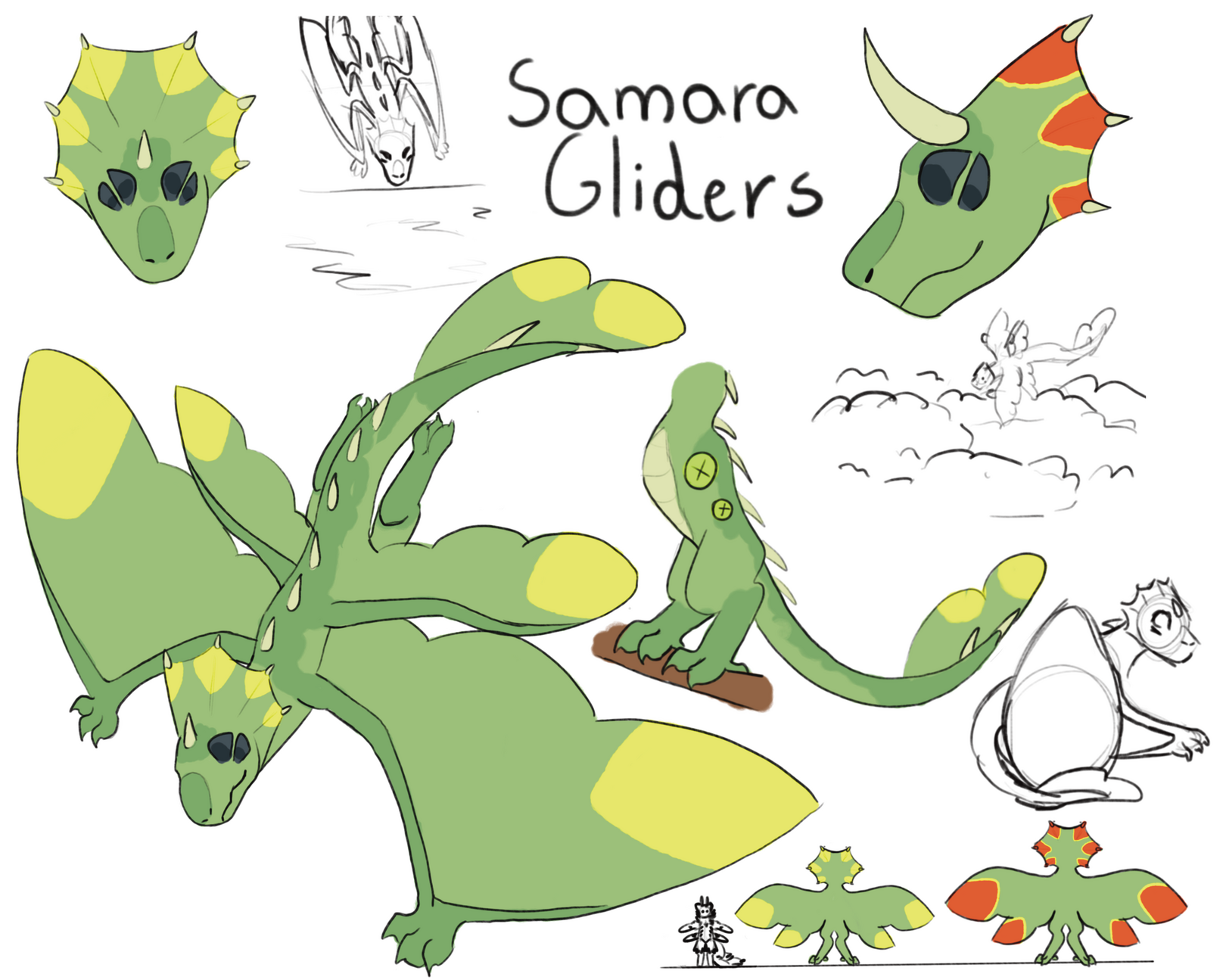
Samara Gliders have huge anatomical and physical differences between males and females. All gliders can perform photosynthesis using their massive wings to get energy and for males this process is their only food source. However, Females are much larger and need to eat meat to sustain themselves. Female gliders are ruthless apex predators that dive out of the sky onto unsuspecting prey, usually killing it on impact. Females will prey upon pretty much any living thing smaller than them aside from male gliders. On cloudy days males become largely inactive but females will become even more violent due to the deficit of calories usually harvested from the sun.
Male gliders are much friendlier and typically form colonies of up to 30 individuals. These colonies are incredibly important for reproduction. Females will asexually reproduce and leave their eggs on the treetops for males to find. Male colonies will take care of the young, ensuring it grows safely. Once a glider reaches adolescence, it will either join the colony if male or venture out on its own if female. While it is largely unadvised to interact with Samara Gliders, on rare occasions, a Calipede will manage to tame and ride a male glider.
Moonboar
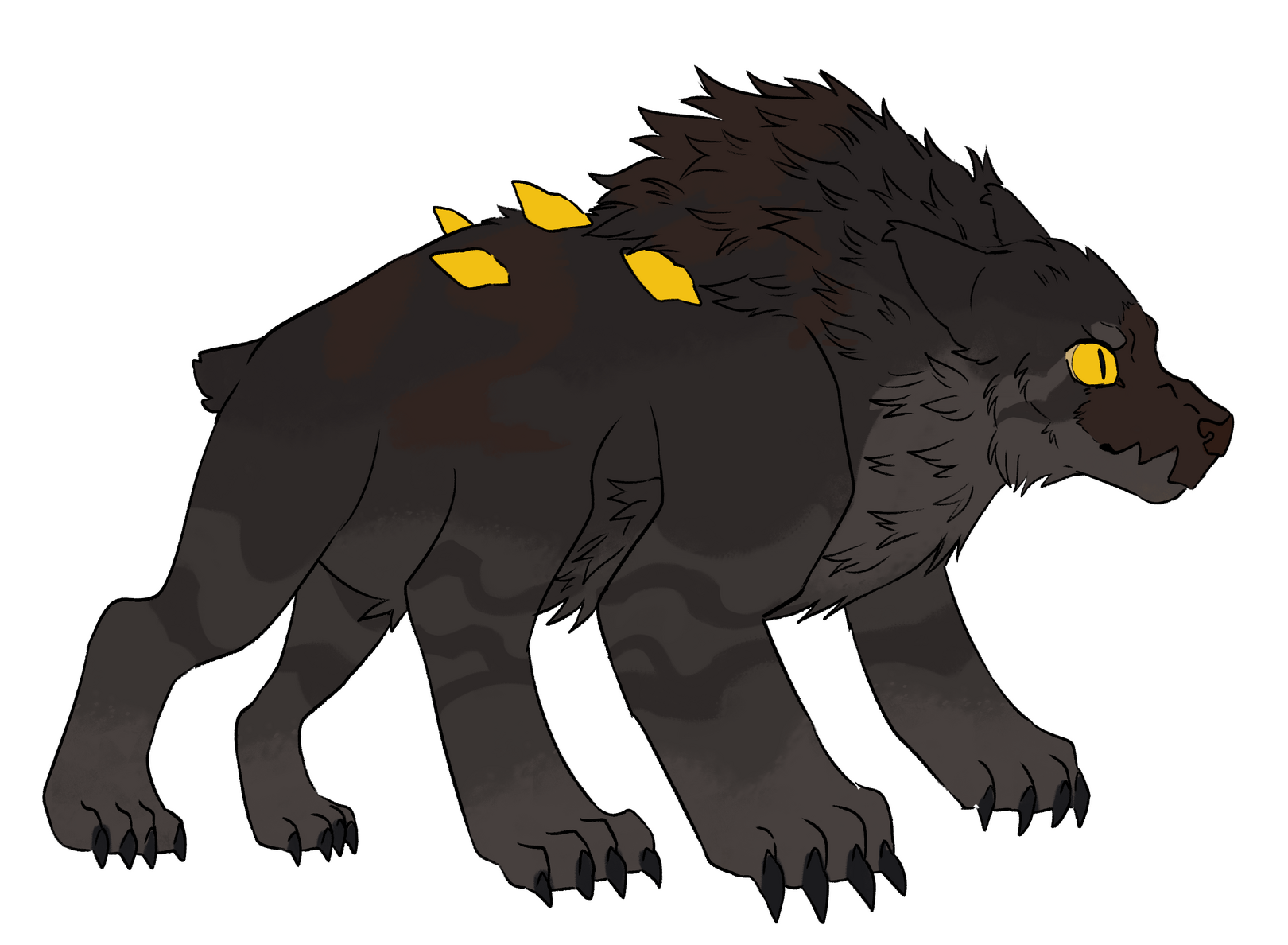
Standing at around twice the height of a full-grown, anthro Calipede. Formerly a Calipede themselves, Moonboars bear conduits as spikes on their back. Attacking these is the only way to kill a Moonboar, though they can be temporarily incapacitated through means of severe injury. These are highly aggressive, tending to attack on sight with intent to kill. They have little discretion in target, going after anything that moves.
Carchar Grazers
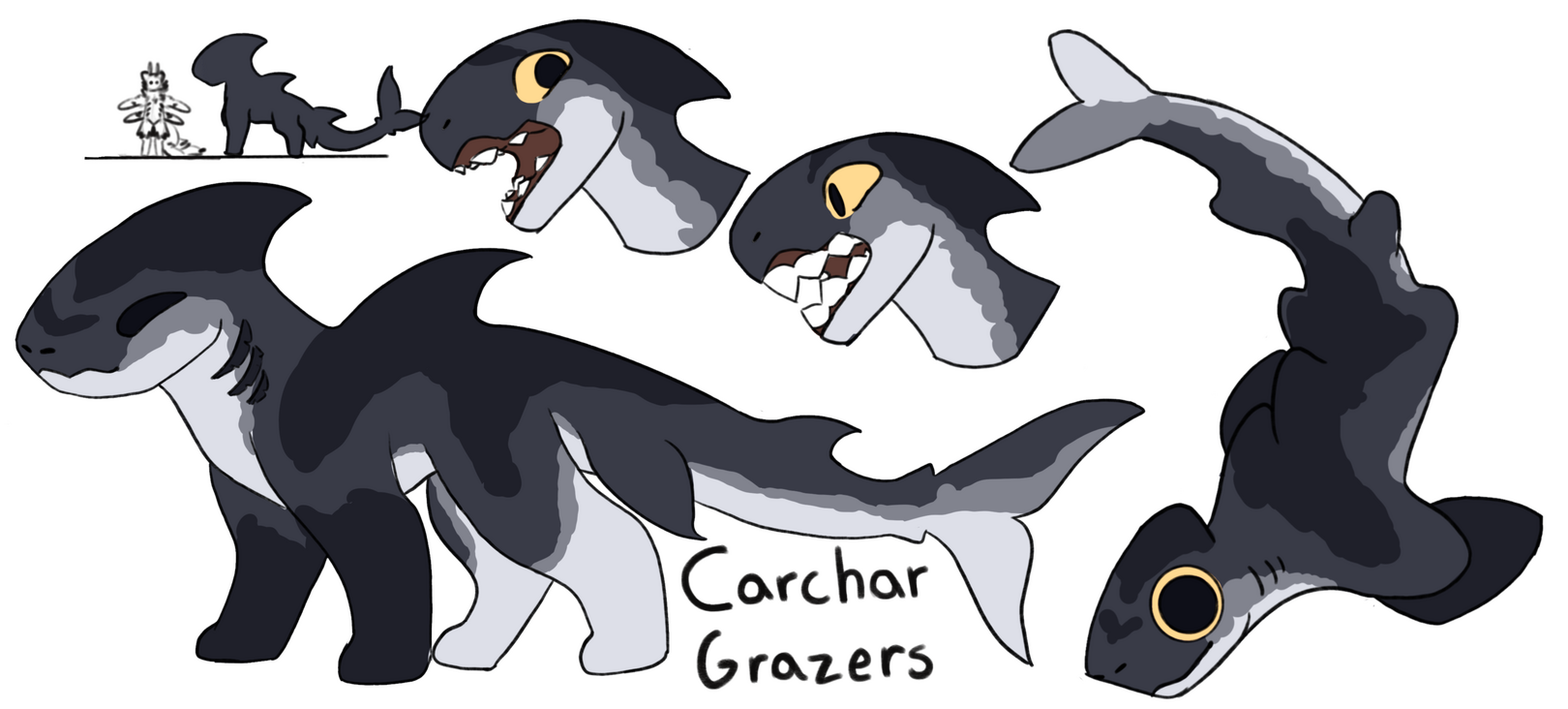
Carchar Grazers are vaguely omnivorous but they mostly eat plants despite their shark-heritage. They travel in large herds and although normally docile, pose quite the threat if startled. Each Carchar is not only incredibly large and strong, but also equipped with sharp, retractable teeth. Adult Carchars keep their eyes closed most of the time due to their bad eyesight out of water. Instead, Carchars rely on their powerful sense of smell and incredibly sensitive skin that they use to detect vibrations in the ground. Due to the extreme sensitivity of their skin, it is incredibly unwise to touch a Carchar as it is a great way to thoroughly overwhelm and aggravate them.
Carchars have a similar life cycle to frogs, giving birth to amphibious young that slowly develop into their adult form. Babies have no teeth and large unfocused eyes. Their only limbs are the appendages that they will eventually use as their front legs. Each nub is equipped with a fin to make underwater travel easier and more efficient. Waterborne Carchars tend to band together and lack parental figures for most of childhood. They sustain themselves by eating anything they can find and swallow whole until they mature enough to go on land. Once on land, an adolescent will join the nearest herd with which they roam for the rest of their adult lives. Carchars can have a wide variety of patterns resembling any shark species and typically tend to form herds with similar patterns for ease of camouflage.
Chirpers
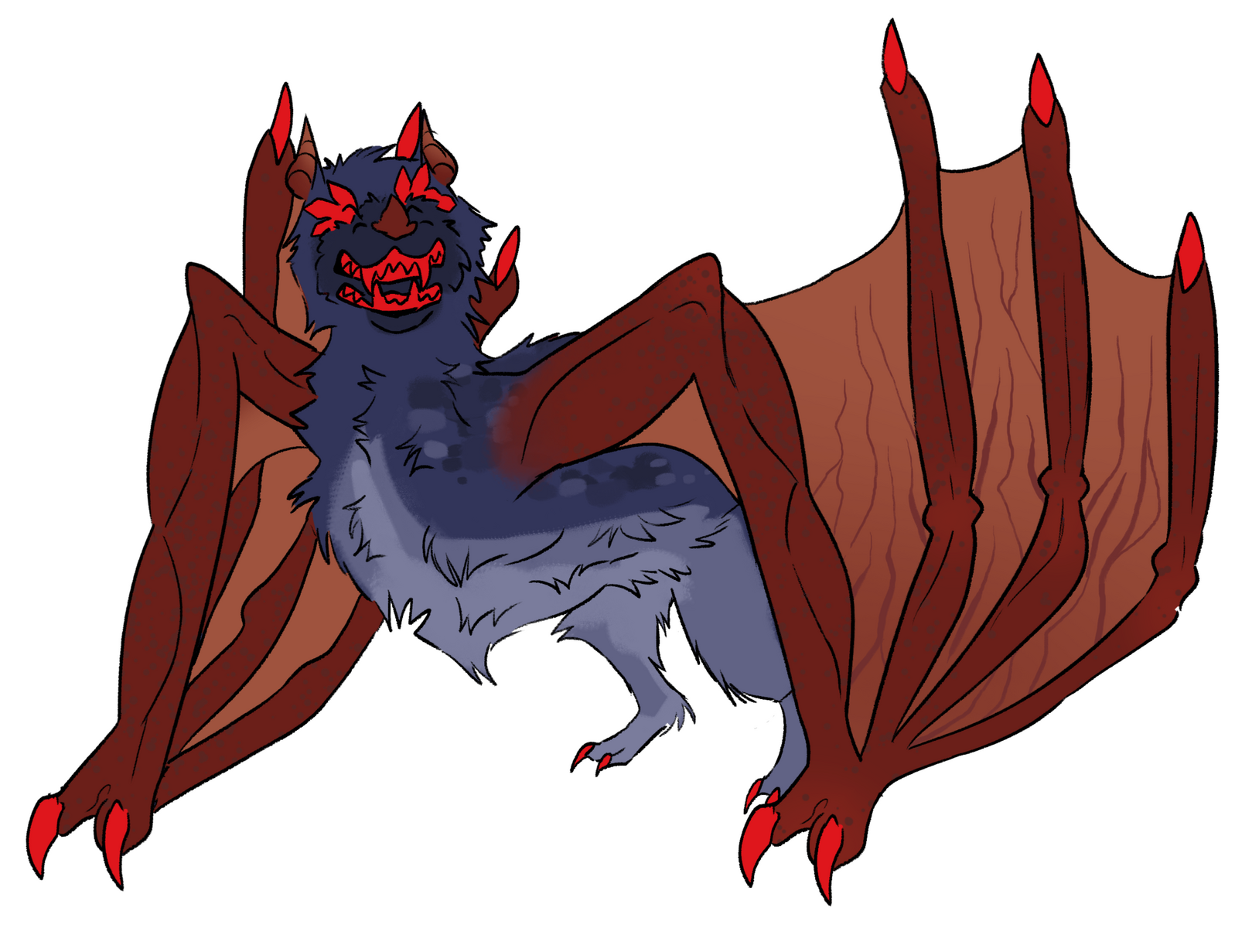
Chirpers are large, bat-like creatures that lack eyes. They use echolocation and smell to navigate their surroundings. Both intelligent and aggressive, Chirpers are stalking predators that pursue specific targets. They seem to understand the language spoken by Calipedes to some extent, but only use this to better formulate attacks. They are incredibly dangerous, and can only be killed by damaging or removing their conduits.
Rifthaven...
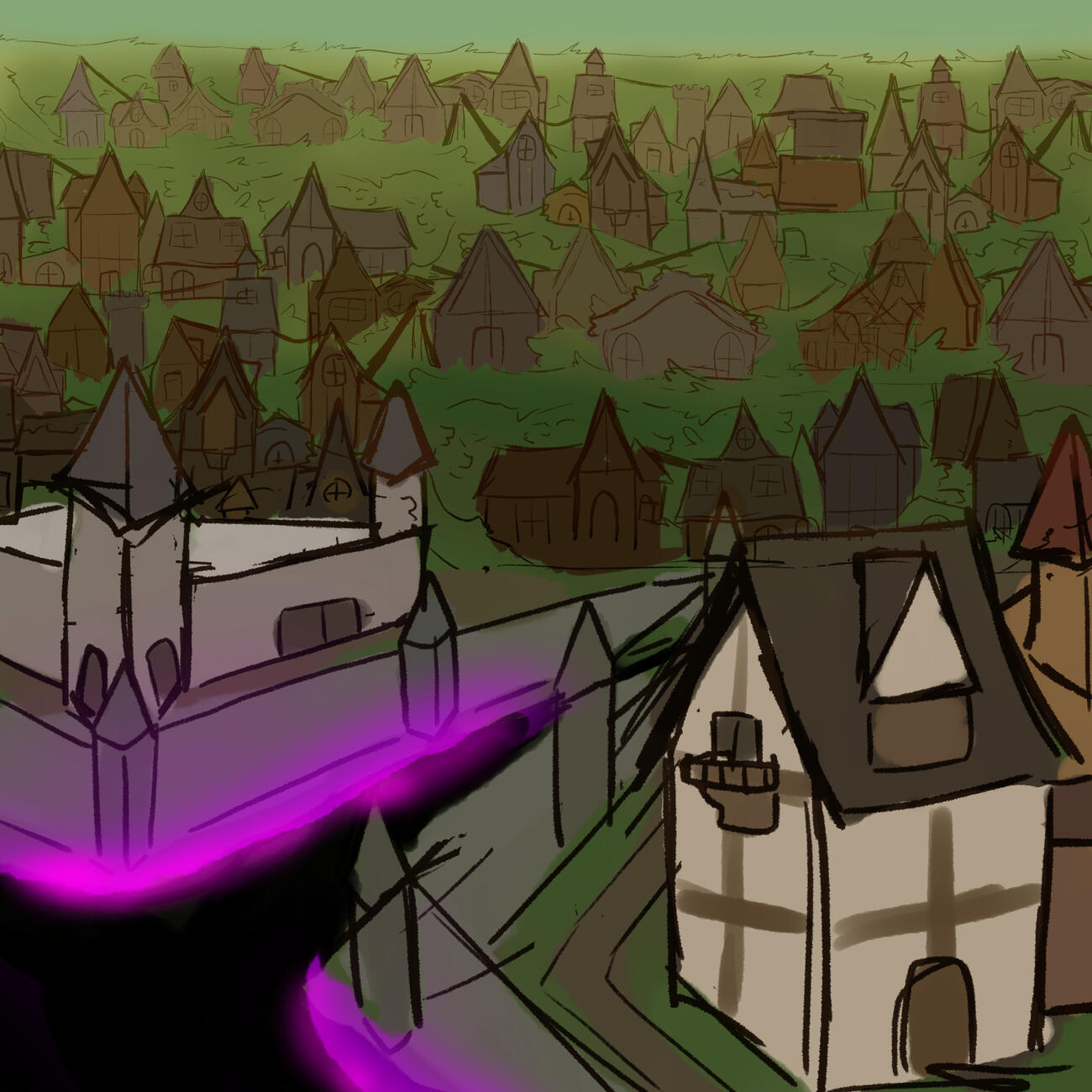
The name Rifthaven refers to the entire Calipede state: city and outskirts. Rifthaven is protected by a magical forcefield called Atheri's Wall, a massive magic border that repels living things from passing through. It stands at an impressive 200 ft tall, making it impossible to pass through for most creatures that might seek out Calipedes as prey. Any flying hostiles are handled by various guilds, who either guard the wall itself or seek out predatory creatures who've made their home too close to Rifthaven for comfort. Checkpoints (places of passage through the wall) exist at the furthest ordinal points of the border. Critters may move freely in and out of the wall through these. From one end to the other, the perfectly circular border has a diameter of roughly 26 miles.The outskirts of Rifthaven are known as the Farmflats, and their use is somewhat implied by that. The production districts lay here, with most of the land being dedicated to farms and ranches responsible for much of the food and textiles material within Rifthaven. Some small suburbs exist out here, too, with small neighborhoods being built around 1-2 larger farms. Folks from the Farmflats respect the value of loyalty, hard work, and community.The Capital of Rifthaven sits within a deepset crater about 200 feet deep and 8 miles wide. The walls, which aren't terribly steep, are home to most of the inner city housing. Residences are stacked high and close together, with informal pathways born from frequent use instead of proper city planning. Houses are added where they can as new Calipedes show up to occupy them, and many travel via ramshackle paths between roofs instead of the ground.The inner capital is home to the industrial district and shops closer to the housing area, with the Rift itself being surrounded by government buildings such as the Sanctuary and the labs. The Rift stretches through most of this lower area, with short (non-magical) walls preventing Critters from slipping into the deep wound in the earth. Stretching a few miles in length and some hundreds of feet in width at its widest, occasional bridges pass over the Rift. Given the brick wall that protects the inhabitants of Rifthaven from its namesake, passage over one of these such bridges is one of the only ways Critters generally manage a good look at the Rift.The population of Rifthaven is estimated at roughly 120,000 Critters, including those under the care of the Sanctuary.
Political Structure
Rifthaven's political structure is democratic! Every year they vote for a new leader, the Keeper of Rifthaven. These votes are held depending on a set of physical and mental trials, as not only is the Keeper expected to make the political decisions, but also to be the front of any military assembly. They make all executive decisions for the city and oversee operations within Rifthaven's borders.Second in influence to the Keeper are the head scientist, healer, arcanist, society leads, and producer's union. These critters influence decisions made in the city by speaking to their specialty and insights. As well, any critter can attend a meeting of the council and speak their voice (during given speaking times) to get involved!
Architecture
Rifthaven as a city is incredibly ramshackle. Its buildings take inspiration from tudor designs, but the buildings are closely assembled and there's no true planning behind the city's assembly. Homes are build awkwardly with bricks and whatever materials are available. The city is densely packed and only easily traversed by someone who has lived there a long time; often the easiest route through the city is by shortcuts over rooftops and through alleyways. The city is overrun with plant life, as well. Utterly verdant, all matter of plants thrive on the roofs, in the patios, and growing on the walls of Rifthaven's buildings.
Jobs and Roles
Rifthaven operates under a vaguely communistic structure; everyone has to pull their weight to the best of their ability, but everyone is cared for, too. Anyone without somewhere to go (especially abandoned or orphaned nymphs) has a home in the Sanctuary, a massive compound formed out of an abandoned bunker (since expanded into a complex tunnel system). The Sanctuary has caregivers responsible for all sorts of maintenance within the Sanctuary; production of food, distribution of goods, child-rearing, etc. These critters are highly trusted because resources within Rifthaven - especially old-world materials they can't recreate yet - are very limited.Farmers and ranchers are very highly valued within Rifthaven. Other jobs include arcanists (those who focus on the development of magic), scientists, scavengers, and riftrunners. You also see a wide variety of standard jobs such as welders, carpenters, etc.Scavengers specialize in leaving the city's boundary and exploring outside, usually in search of resources. They deal with dangerous creatures the whole way through, as well as crumbling architecture and the dangers of the wasteland. This is the only way that Calipedes have access to many resources, however, so it's a very necessary job.Riftrunners do very much the same job as Scavengers, but instead they're entrusted with keeping those inside the rift inside, occasionally venturing into the rift themselves.
Holidays and Traditions
Harvest Fest & Hallow's Eve
October is the season of the harvest! It's a very busy time as everyone helps the farmers to prepare their crops for a big feast on Hallow's Eve! The Harvest fest involves music, dances, family activities, and all manners of getting the community involved. It's a warm time of year where the community comes together to celebrate the changing seasons and prepare for winter. On Hallow's Eve itself, all critters (especially nymphs!) are encouraged to dress up in silly costumes. It's only a fun tradition, there's no real reason for it, surely...
Hearthmoon
Hearthmoon happens in late December - early January, celebrating the community of Rifthaven through the hardest seasons of the year, and the struggles that come with that. Hearthmoon is two weeks of festivities that focus on spending time with loved ones, giving back to the community, and helping each other. It also is a time of displaying bravery; as resources run thin, brave volunteers must venture into the wastelands - ever more dangerous in the cold - and bring resources back for the city.Hearthmoon is also a time for celebrating the dead, as the death of the plants and silence of life that accompanies a harsh winter seems to bring spirits closer to home. Necromancer Arcanists often perform large displays where ghosts are made visible as apparitions to speak with their loved ones. During this time, sensitive critters may even look for unaccompanied souls - those who died so long ago they have no remaining connections, orphans, and those who were alone in life - and seek to help put them to rest. Whilst seeing the ghost of a loved one is a cherished moment, it's equally as celebrated when a ghost no longer appears, signaling that the dead one has moved on into whatever speculative afterlife awaits.
The Wild Hunt
Though spring brings new births and a time of flourishing for those within Rifthaven, the same is true for its enemies... a militia is formed of willing critters to go outside of Rifthaven's borders and systematically thin the populations of predators that might otherwise threaten to overwhelm the energy barrier around Rifthaven. The Wild Hunt is a long journey around the outskirts of the barrier, killing any potential threats whilst also searching for any potential resources unearthed by the winter.Within the bounds of Rifthaven, those waiting for the Hunt to return prepare a feast and gifts for the hunters, as well as helping healers to prepare for any injuries. There is a big celebration when the Hunt returns, signaling the beginning of a new year.
Summer Solstice
The Summer Solstice is a night of festivities! The Carnival comes to town and the longest day of summer is spent playing games, having fun, and enjoying the warmth. Many critters try to stay up the whole night long celebrating, carrying their festivities to dawn. Akin to the old-world tradition of fairs, the carnival sports performers, entertainment, and ill-conceived food!Summer also brings a celebration of the differences between critters. A brief festival is held in the center of the city, showcasing the diversity Rifthaven holds so dear to its heart. This usually occurs a little earlier in the summer than Solstice.
Anatomy
Calipedes are very biologically flexible creatures, capable of switching between walking on their hind legs or all fours at will. Their DNA is very malleable and built to adapt to their environment, so a Calipede's adaptations and appearance will change drastically during their lifetime. All Calipedes share in a few basic traits, however. These include conduits, a storage system on the outside of the body that allows a Calipede to harness the arcane. Without conduits, arcanic energy would store itself in the Calipede's body, an amount of energy which isn't sustainable and would quickly destroy the Calipede's internal organs. There are 6 conduits on the core body, symmetrically distributed around the spine, placed on the flank or back. Then there is a Stinger conduit located at or near the tip of the tail, (which can be split into multiple individual conduits, by default it is two on a standard Calipede) and two antennae on the head. While these can be placed and shaped in different ways depending on the individual, they are critical to the Calipede way of life.Calipedes are relatively small, standing at the shoulder at about 4-4.5' on average when on all fours, 5-7' on hind legs.
Life Cycle
A Calipede begins its life within an egg, though that term is used... lightly, to say the least. On account of the effects of both nuclear radiation and the effects of the arcane on the body, Calipedes lack functioning reproductive organs! Instead, any two Calipedes will find a reasonably sized (think watermelon) hollow object and use magic to fertilize it. The object is filled with a Reproductive Elixir and both parents place biological matter (usually blood) into the solution. The egg is then fertilized and is closed, where it will need to be kept warm for 4 months before it can hatch. The elixir naturally thins the exterior of whatever object formed the "shell" of the egg (making it increasingly fragile throughout incubation) so that the nymph may emerge without fear of suffocation.Nymphs are born fragile, with closed eyes and small, folded ears, alongside having 4 legs and 2 tail stingers, but no flank conduits. Additionally, their antennae are curled atop their head. They spend the next few months developing, growing into their limbs and opening their eyes and ears. They also will experience some changes during this time, though mutations are generally mild in nature and not very impressive.When they are ready, Nymphs will go through a metamorphosis. Ceremonially, it's traditional that friends and family help them build a cocoon to nest in for their metamorphosis. This is a dome woven from various materials about twice the size of its eventual inhabitant. At the time of metamorphosis, a nymph will crawl inside and begin to transform, a period of time during which they will go "dormant" for a period of a week, emerging with their adult traits at the end. This process can only happen when a critter truly feels safe, as the process of metamorphosis is very delicate and involves their body being defenseless for a long period of time. Traditions regarding this time vary between different families, but often it's traditional for gifts to be left for the emerging critter (often those used in home-making, as the transition to adulthood means they're now likely to live on their own) and for them to be talked to through the dome.An adult Calipede emerges from their cocoon with unfurled antennae, the ability to use arcane magic, and sometimes a new set of limbs. Their bodies are more developed and they've sprouted 6 flank conduits as well. An adult Calipede will go into the world, find an occupation, and find their own place in Rifthaven and the wider world. Calipedes do not noticeably age after the point of metamorphosis, remaining fit and young indefinitely.
Injuries and Illness
Due to their innate magic, Calipedes are very durable. They can withstand extreme conditions and injury without succumbing. Whether it be holding their breath for long periods of time, surviving extreme amounts of blood loss or traumatic injury, or subzero temperatures, Calipedes are capable of enduring much. While not invincible, Calipedes don't die of "natural causes"/aging, as their natural regeneration will keep their bodies in a state of healthy adulthood indefinitely. Extreme trauma can also do a critter in, but it takes a lot to kill one. This doesn't mean extreme injury doesn't happen, however. Though they may survive, magic can't always repair a mangled or destroyed body part, especially if it's biologically complex. Eyes and limbs especially have a hard time regenerating once lost, usually impossible to repair. The same goes with severe head trauma and spinal damage, both of which are very complex and difficult to repair smoothly or without inadvertently worsening. Sickness and infection do happen, but are less severe than in other species.The most frequent cause of death for a Calipede is the removal of one or more of their conduits from the body. Without their conduits, a calipede not only has impacted access to and control of their magic (including their natural healing abilities), but are also prone to being overwhelmed by the arcane.
Traits
Though the standard traits of a Calipede are very simple; consisting of small ears, a fuzzy body, and soft features, one look at Rifthaven reveals that many critters do not follow this reputation remotely. Instead, critters with horns, wings, many tails, short fur, and strange features can be seen roaming the streets of Rifthaven. Why is this?Traits are a natural part of the Calipede life cycle! They're a part of what makes a Calipede so adaptable: the ability to change their traits to fit their environment as seen fit. This can take many forms, and many Calipedes have traits for all sorts of reasons. For some, it was a choice, for some the change symbolizes an internal metamorphosis come physical, and some traits may be spurred by trauma as a survival response. Traits stem from all sorts of places depending on the critter and circumstance. Some reasons are deeper than others, and some are completely inexplicable.
Character Creation (Lore)
Stuck on building a backstory or lore for your Calipede? Here's our guide!
Calipedes created from Default MYOs are a bit more limited in their lore. A nymph should be relatively young (anywhere from a newborn to teen) at the time of creation, lore wise, and their backstory should function accordingly. These nymphs were hatched in Rifthaven, but what they're up to can be up to you! Maybe they have loving parents and a nice home in the capitol, or were abandoned/orphaned and live in The Sanctuary! Perhaps they've run away from home and are working pity jobs out in the rural areas, or have been caught messing with the borders multiple times now.Nymphs don't come out of nowhere, who are your Nymph's parents? Maybe they were part of the Guard's Guild and killed on a mission, or they went (or were dragged) into the Rift and never returned. Maybe they're present and loving (or not!), in which case you can either make them unofficial NPCs (unable to be counted for Tabs) or made official through an MYO!Nymphs are as capable as adults of having interests and complicated relationships with those around them, so feel free to explore that! You are also always welcome to headcanon a relationship between your Calipede and an NPC!Non-default MYOs can also have standard backgrounds: born and raised in Rifthaven to some capacity, etc. They can also be Riftborne, however. The Riftborne are critters that came out of the depths of the rift, often with memories of past lives. Officially, this is considered to be a symptom of riftsickness, delusions caused by the arcana well... but who knows whether the officials in charge of such documentation tell the truth or not. Regardless, many Riftborne critters remember past lives, and not necessarily those that ended in death. For many Riftborne, their previous lives ended in being dragged into an infinite darkness, only to awaken in a new place, crawling out of the rift and into the capitol of Rifthaven. They don't remember their time between lives, either.Riftborne critters can be any age.[ Riftborne Critter lore can be pretty expansive and isn't heavily monitored by staff! You can create a detailed web of interconnected lives, or leave it pretty simple. You can also make a Calipede who's been a Calipede before, having been reincarnated days or even years after their previous death/disapearance. The only limit here is that CBCs cannot have "past lives" that are their literal Character Source (ie: Bakugo CBC is Riftborne and was previously living as Literally Bakugo from MHA), for the sake of not breaking intellectual property rights. They can be inspired, however, 100%. ]Regardless of being born-n-bred in Rifthaven or having crawled out from the eldritch hole that the Calipedes find shelter around, all Critters come from somewhere, have people who care about them, and are doing things with their lives. Explore some ideas for occupation, hobbies, and life goals or traumatic backstory! Roleplay with other members and participate in quests! There's plenty of ways to build a backstory for your Calipede, and you can always ask the server for advice for a jumping-off point!
Guilds and Organizations
Guilds describe a network of Calipedes that serve a variety of purposes around Rifthaven. There are often many critters in each as a sort of alternative to the standard job options.
While the first guild is open to all critters, we will have some later that require special invitation...More will open after Adventurer's Guild has test run some features for a bit!
Guild Mechanics
Each month, the Job Board will post 1 Quest for each guild. These will be higher effort, higher reward quests. Each critter can only be registered to 1 Guild. A given critter must be an adult in order to qualify for a guild membership.
Despite having a "bounty", each quest can be completed by any amount of guild members (and by the same user, granted they have multiple critters in the guild). It is not first-come-first-serve.For a given quest, you will complete the assigned work (2 characters on a complex background, 1k words, etc) and submit it to the quest thread. Regardless of how you roll following this, you will receive the bounty for the prompt.
Then, we will roll a d100. The higher you roll, the better rewards you get. Your rolls can be boosted by:
The presence of a pet adds 1d10 per pet to your roll. These must be registered pets.
The use of arcana (gained through completing arcanic quests) adds another 1d10 to the roll.All rolls will be done using a dice bot in-server.
Guilds
All text regarding party size is for gauging which guild suits a character best, given their personality and skills! The flavor text has no mechanical bearing, however.
The Adventurer's Guild [OPEN]
The "Odds-n-ends" guild of Rifthaven, the Adventurer's guild works equally on private and public contract. Sometimes they fulfill jobs for the people of Rifthaven, sometimes they're on orders from the City. Regardless, they're pretty much always jobs that require critters to leave the bounds of the city and its safe zone, exploring the ruins beyond. This guild is good for those with a deep sense of wanderlust, those who need to explore and find new things, and those with a nonexistent sense of self-preservation. The Adventurer's guild members tend to see themselves as some sort of big family, and it's very rare for a critter to be sent alone; most job fulfillments see parties of 4-8 being sent out.To join, users are prompted to draw their critter in attire appropriate for an adventure! This is a pretty loose prompt and can consist of just about anything, depending on what "preparedness" means to your critter! The guild isn't very strict, and certainly isn't one to turn away eager help...
The Riftjumper's Guild [CLOSED]
Dedicated to gaining knowledge and understanding of the Rift, this guild specializes in sending teams into the horrifying pit that quarters the city. The job is dangerous but always exciting. It's similarly enticing to those with little sense of self-preservation and less waiting for them at home. It's also a great option for the scientifically minded, as research and notable findings within the rift serve as a great entry point to deeper scientific discovery... and the attention of those in power. The Riftjumper's Guild tends to be more friendly to those who prefer their own solitude, as explorations and jobs are usually only attended by groups of 1-3 Critters.
The Restoration Project [CLOSED]
The Restoration Project critters have dedicated their work to making discoveries about the civilization before them, learning about the history of the natural world and beginning to attempt its recovery. These are historians whose life goal is the acquisition of understanding who lived before them and what happened to their world. Their missions are a bit on the tamer side, involving parties being sent to the cities and towns in search of new information, but encouraging researchers to shy away from fights and danger. Exploration parties are usually well-funded by the city itself and often include upwards of 10 critters.
Curses
Curses are medical afflictions gained through contact with a cursed individual. They’re like an arcanic disease, affecting the body’s connection to the arcane and changing their body involuntarily. Each Curse has 3 “Safe” stages, with each progression of the curse’s effect chipping away further and further at a critter’s mind and sense of self.At stage one of a curse, a Calipede experiences unusual urges and mild symptoms. They usually aren’t in severe pain or unduly agitated and are fully of their own mind, though an affected critter may behave oddly, experiencing harmless but strange new behaviors.At stage two, the progression of the curse leads to more discomfort in one’s own body and the urges get harder to resist. These are not yet compulsions, but take mental effort to work against. The symptoms may be causing erratic behavior and levels of pain.At stage three, a Calipede becomes increasingly agitated, likely to lash out. Strong force of will dictates whether or not they become violent, giving in to the intense urges. Curses at this stage can be nearly unbearable, with significant pain and bodily discomfort. They also experience brain fog, leading to bouts of amnesia and confusion.After stage three, a Calipede’s curse cannot be returned from. The mind gives in and the body follows shortly, with the calipede transforming into something completely alien. They become almost completely unrecognizable. They attack with little discretion.Mechanically, curses change the Arcanic color temporarily, with it reverting back to its original color when cured. The Arcanic color change affects all conduits (tail, sides, antennae) and scars, which should become a lighter or darker shade of the new color. While cursed, each stage progresses on a bi-monthly basis; you optionally move from stage 1 to stage 2, two months after you got stage 1. The progression of curses moves through art and writing prompts. How far you take the lore implications is up to you, but note that for the time being, Grimoire has yet to discover how to cure these afflictions.
Current Known Curses
Moonbound Curse
Magic spreads artificial adrenaline through the critter’s endocrine system and makes the body consume more energy than usual, often requiring a high protein diet to keep up with increased caloric demand. Cursed calipedes often experience intense craving that can result in violent urges. Extended periods of fasting like sleep drastically increase violent impulses and behavior.
Arcanic Anemia
Increased blood loss results in a type of anemia. Cursed critters struggle to stay warm and often feel faint. Victims also experience extreme hunger and desire for the blood of others in response to their own deficit.